

Perspective
The Car Is Not a Victim. It Is the Most Privileged Mode of Transport

Robert Joseph Martin, PhD
Partner, Beta Mobility
The debate about urban transport is often framed as a choice between a car-free city and no regulation at all. That framing is misleading. The car is not being eliminated. It is being asked to take part in a more balanced system, where space, safety, and public health are distributed more fairly.
Cars and congestion: a capacity problem, not a space shortage
When congestion and parking pressure are experienced as problems, they are often interpreted as arguments for giving more space to cars. In practice, they usually point in the opposite direction: the number of cars has exceeded the capacity that dense urban areas can realistically accommodate.
For years, car interest organizations have been among the most persistent voices in the Danish mobility debate. During the municipal election campaign, the discussion about urban transport was once again sharpened and reduced to questions of parking and conditions for motorists.
Less than two months later, the same narrative has returned. The argument is familiar: that the car is being pushed into a defensive position, and that regulation of car access and parking creates inequality. The issue is not that this argument is made. The issue is what is left out.
A long-standing imbalance in how urban space is allocated
The car is often portrayed as a victim of political intervention. In reality, it remains the most privileged mode of transport in Denmark's transport system.
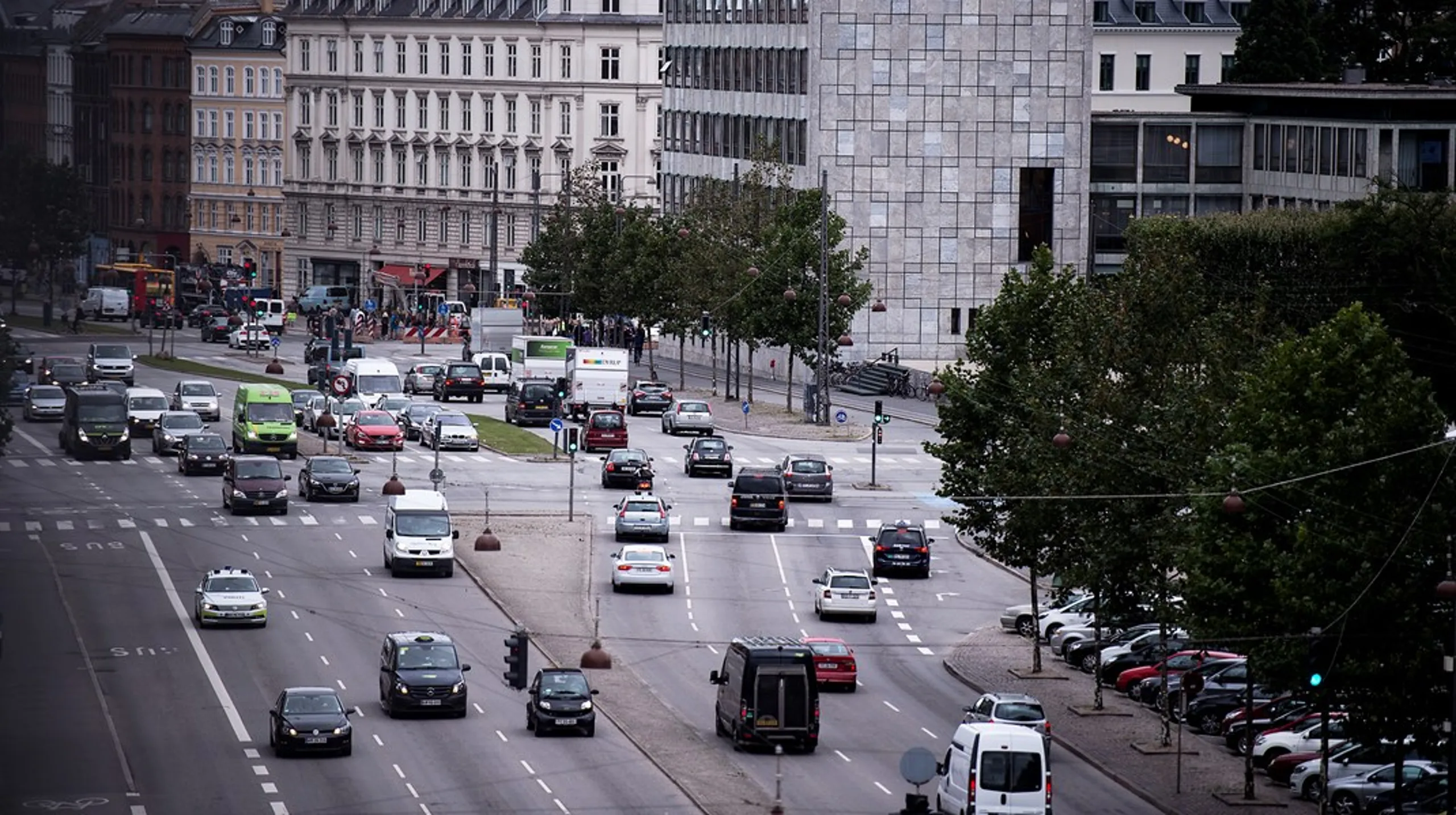
For decades, the car has been the structuring point of departure for infrastructure, investment, and land use. This also applies to Copenhagen, often highlighted as an international cycling city. The city's own figures show that cars occupy around 58 percent of the space between buildings. This is the city's largest continuous public resource, and most of it is reserved for cars.
When the majority of this space is allocated to a single mode of transport, it is not a neutral condition. It is an active distribution choice. Space that could support many is tied up for the benefit of few.
Reducing parking and reallocating street space is therefore not an attack on equality. It is a correction of a long-standing imbalance.
Election results do not show a backlash against green mobility
It is often argued that the municipal election campaign showed broad public support for better conditions for cars. This is a selective reading.
In cities such as Copenhagen and Aarhus, election results did not confirm a voter backlash against green mobility. In Copenhagen, parties supporting reduced car traffic and reallocation of urban space gained more seats overall, while parties advocating better conditions for cars lost seats. In Aarhus, the coalition behind the green mobility plan retained power, while the only party actively opposing the plan was excluded from the governing agreement.
Why the car dominates the debate despite lacking majority support
The continued dominance of cars in public debate does not necessarily reflect majority priorities. It more often reflects a relatively small and well-organized minority. This voice is amplified through media coverage, where conflict and scarcity tend to receive more attention than proportionality.
When congestion and parking pressure are framed as problems, they are often used to argue for more space for cars. In reality, they indicate that the number of cars has surpassed what dense cities can realistically handle.
Retail and parking: selective use of research
Claims that international research shows reduced car access and fewer parking spaces harm retail do not hold up under closer scrutiny. In several cases, the research shows the opposite: limiting car access often has positive effects on turnover.
Retail is not used here as an object of analysis, but as a shield.
In the run-up to a municipal election, a business organization presented a case linking the removal of parking to smaller shopping bags. Less visible was the fact that total turnover had increased. One partial figure is highlighted. The whole is omitted.
This is not an isolated example, but a recurring pattern in car advocacy. Facts are simplified, research is reinterpreted, and complex relationships are reduced to headlines that protect the car's position in the city.
Electrification does not solve congestion, space, or safety
It is true that cars today emit less CO₂ per kilometer than before. The problem arises when this technical improvement is used as an argument against regulation. A narrow focus on tailpipe emissions ignores other impacts that scale with traffic volume and vehicle weight.
Recent research shows that non-exhaust particles from tires, brakes, and road surfaces make up a large share of local air pollution, including from electric cars. These emissions are not reduced through electrification, but through fewer and lighter vehicles.
Electrification also fails to address the city's other challenges. An electric car takes up exactly as much space as a fossil car, both when moving and when parked. Traffic safety is still affected by vehicle mass, speed, and volume, regardless of drivetrain. Noise, inactivity, and harmful particles do not disappear simply because the car runs on electricity.
Technology changes the energy source. It does not change the car's systemic consequences in society.
A false choice between car-free cities and no regulation
The debate is often framed as if the alternative is either a car-free city or no regulation at all. This is a false dichotomy.
The car is not being eliminated. It is being asked to take part in a more balanced system, where space, safety, and health are distributed more fairly.
Portraying this correction as inequality is not an analysis of the city's challenges. It is a defense of a privilege that has been taken for granted for decades.